Whitepaper
The Economy of Words
Economy of Words is a 2,048-minute writing.
For 2,048 minutes — just over a day — anyone can write a line from the 2,048 words. With the symbols between them it becomes an equation: EFFORT × LOVE = BEAUTY. When the window closes, it is sealed. No additions, no redos. What got written is what there is, forever.
This explains why it is built that way, and what the window leaves behind.
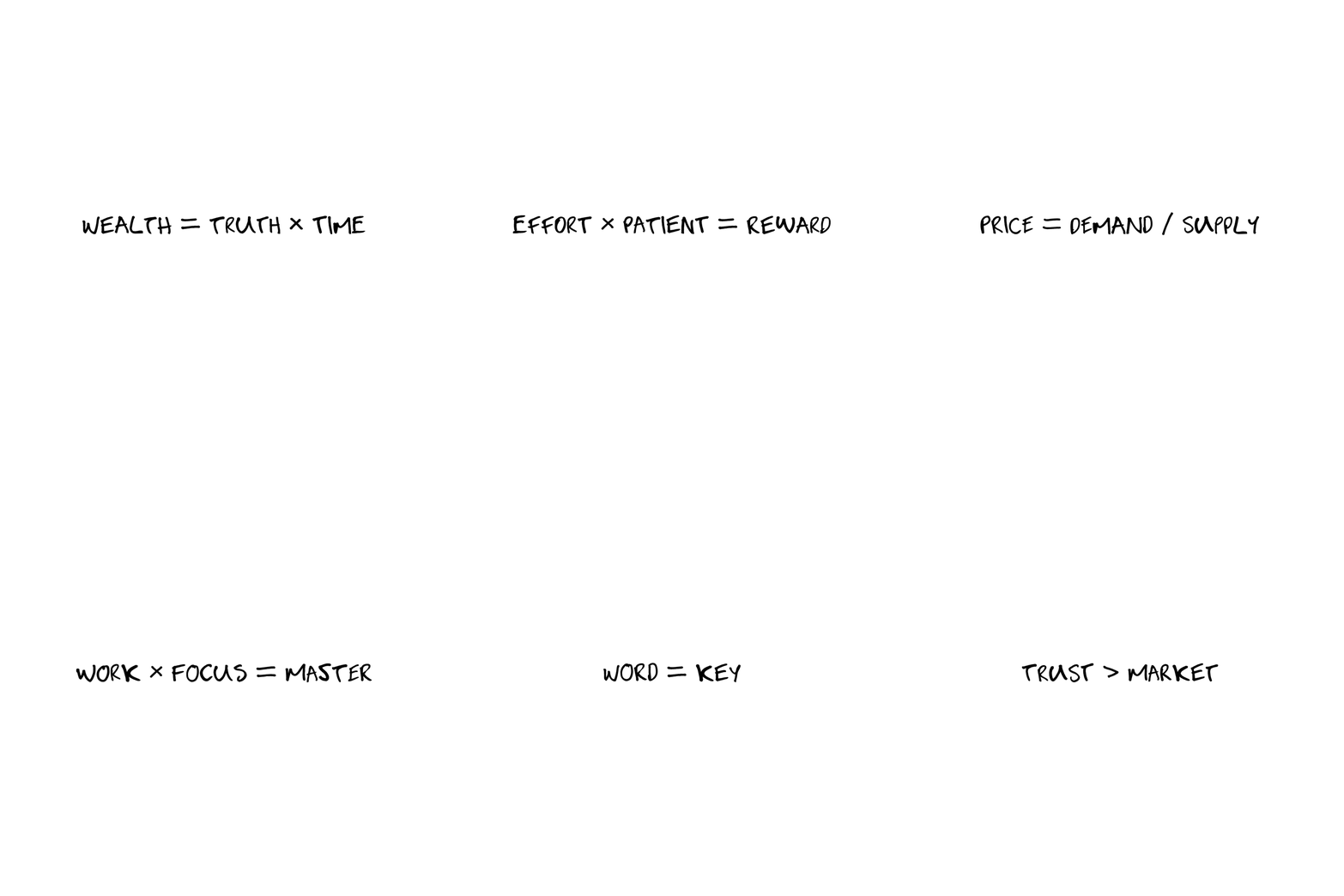
Words repeat, expressions are 1/1
Words can be reused; expressions cannot. TRUTH can appear in a hundred lines, but EFFORT × LOVE = BEAUTY can be written only once, by the first person to write it. That is how language has always worked, a vocabulary everyone shares, and sentences only you say. Here the sentence becomes a one-of-one.
A phrase only names things. An expression, with the operators between the words, argues a relationship between them, in the one notation that wears the look of proof. You are not pointing at things; you are claiming how they relate.
Every line is a holograph
You pay a dollar a letter, and $20.48 for the holograph: the line drawn out once, entirely in my hand, and shipped to you. A holograph is a document in the author’s hand alone, a holographic will needs no witness and no notary, because the handwriting itself is the proof.
There is no digital-only tier. To write here is to receive the hand. Everyone who writes leaves with the original, and the price is simply the cost of the strokes: a dollar a letter, because every letter is one I draw.
The holograph · drawn by hand, one of one
The scarcity is the window
The words are not scarce. The window is. Two thousand and forty-eight minutes, one shot, and the wall fills with whatever a crowd decides to say, then closes for good. You cannot write tomorrow what you did not write today. That is the whole pressure of the thing, and the reason it is a happening and not a shop.
The record is the artwork
Because words recur across thousands of singular lines, the window leaves a record: which words were written the most, what a crowd actually paid to say. Not a poll, not likes, the words people spent on, in their own hand.
When it seals, that record is the work as much as the wall is, a portrait of what one moment valued, ranked by conviction and drawn by everyone who showed up.
Why these words
They are not random. The 2,048 are the ones that, in the right order, — a Bitcoin seed phrase, the one vocabulary where a word is value. We gave a crowd 2,048 minutes to write with them, and to say, in the words that hold the most literal value there is, what they actually value.
Epiphany, where it started
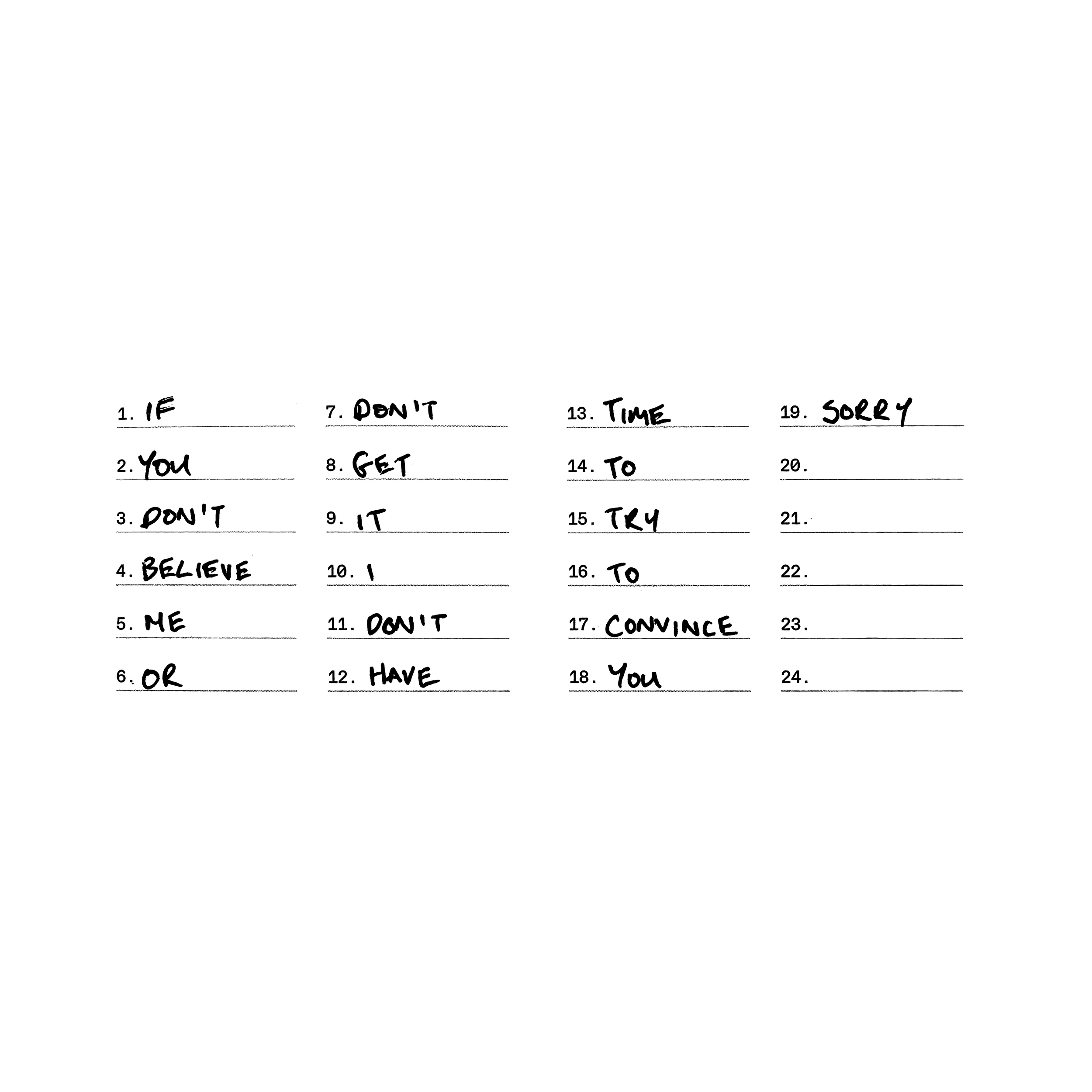
It began with Epiphany, in 2021. The piece takes a line from Satoshi Nakamoto — “If you don’t believe me or don’t get it, I don’t have time to explain it to you, sorry” — written by hand into the form of a recovery card. The quote is exactly nineteen words. A seed phrase is twenty-four. Five slots left empty, on purpose: a phrase is never handed to you finished, you complete it yourself.
Economy of Words hands a crowd the same pen, and 2,048 minutes to use it. You write the line; no one writes it for you.
What you are writing
Not an investment. A line in a 2,048-minute collective writing, in your hand, sealed forever, and your mark in the record of what a crowd valued.
Write something worth keeping. You only get the one window.